
The Avery Huffman DIPG Foundation Announces First of Two New Donations to West Coast-Based Labs
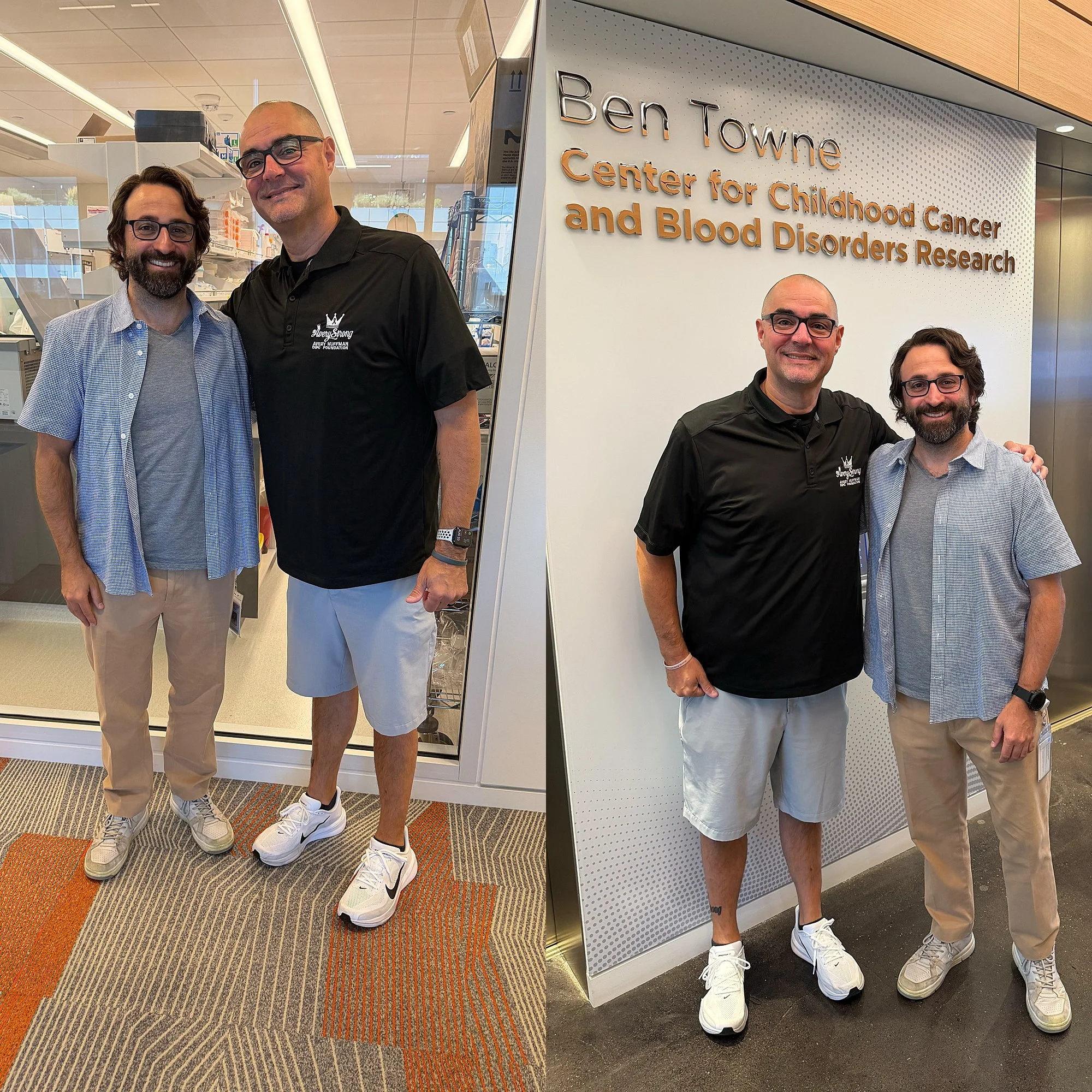
Dr. Nick Vitanza of the Vitanza Lab at the Ben Towne Center for Childhood Cancer Research at Seattle Children’s Hospital and the Avery Huffman DIPG Foundation’s executive director, Brandon Huffman.
The Avery Huffman DIPG Foundation (AHDF) is announcing the first of two new 2026 contributions to research labs on the West Coast.
As Childhood Cancer Awareness Month begins on Tuesday, September 1, the AHDF has announced their first of the pair of donations for 2026.
This particular lab holds significant meaning to the Avery Huffman DIPG Foundation- The Vitanza Lab at Seattle Children’s Hospital.
The Vitanza Lab, headed by Dr. Nick Vitanza, is part of the Ben Towne Center for Childhood Cancer Research at Seattle Children’s Hospital.
The Avery Huffman DIPG Foundation has donated an additional $50,000 to the Vitanza Lab after making previous gifts of $100,000 to the lab the previous three years.
That brings the total to $150,000 to the Vitanza Lab over the last four years.
In addition, once again, a substantial donation to the Avery Huffman DIPG Foundation came in May of 2026.
In May, East Ridgefield CrossFit, Ridgefield Rumble and the Draper family communities held a CrossFit Competition that came together to honor Wyatt Draper—a courageous DIPG angel warrior from Southwest Washington—and raised an amazing $18,485 for DIPG research.
Upon Avery’s passing in February 2016, her tumor and brain were donated to the Monje Lab at Stanford University and cultured cells have been used in over 30 hospitals around the world and in research projects done by Dr. Monje, one of the most renowned DIPG-specific doctors in the world. A former partner at the Monje Lab, Dr. Vitanza now heads the Vitanza Lab at the Ben Towne Center for Childhood Cancer Research and he too uses cultured cells from Avery’s tumor for his research and treatment, which is one of the most well-regarded DIPG treatment programs in the United States.
“Being able to continue to support Dr. Vitanza, who has made it his mission to fight DIPG and DMG and find a cure is what continues to motivate us to fight back in Avery’s name,” said Brandon Huffman, the executive director and co-founder of the Avery Huffman DIPG Foundation. “It has been over a decade since Avery took her last breath here on earthy, but the bleak hope we were given and the outcome she suffered are why our foundation exists. Thanks to the tireless work and efforts of Dr. Vitanza, there is far more optimism for newly diagnosed patients. As the Avery Huffman DIPG Foundation has spent over a decade fighting for a cure for DIPG and raising awareness, we continue to be grateful for the commitment to finding a cure and fighting for these children that Dr. Vitanza is committed to.”
The Avery Huffman DIPG Foundation (previously known as the Avery Huffman Defeat DIPG Foundation), has previously supported both the Vitanza Lab, in partnership with other foundations and in specific projects.
This round of funding is as a standalone foundation and approved by the board of directors of the Avery Huffman DIPG Foundation, which includes Darin Padur (treasurer), Michael Jeremiah (secretary) and Dr. Suraj Singh, the board’s resident oncologist and Avery’s radiation oncologist, as well as Brandon Huffman and Amanda Huffman, Avery’s mother and the co-founder of the Avery Huffman DIPG Foundation.
About Dr. Nick Vitanza:
Dr. Nicholas Vitanza is a pediatric neuro-oncologist and translational scientist whose career is dedicated to the care of children with high-grade CNS tumors, particularly diffuse intrinsic pontine glioma (DIPG), diffuse midline glioma H3K27M-altered (DMG), and atypical teratoid rhabdoid tumor (ATRT). During his pediatric oncology fellowship with Drs. Bill Carroll and Elizabeth Raetz at New York University, laboratory projects led to a COG clinical trial and an ASPHO award. He completed a second fellowship in pediatric neuro-oncology at Stanford University and a post-doc in Michelle Monje’s neuroscience/DIPG Lab, in which he performed high-throughput drug screens in patient-derived DIPG models and mechanistic analyses of epigenetic vulnerabilities in DIPG. This work led to publications in Cancer Cell and Science Translational Medicine, as well as a phase 1 clinical trial. In 2016, Dr. Vitanza joined the faculty at Seattle Children’s Hospital. His work and the work of the Vitanza Lab has focused on creating treatment-naïve biopsy-derived patient-derived DIPG/DMG models, discovering targetable molecular and immunologic vulnerabilities in these tumors, and translating these findings into innovative new clinical trials. Dr. Vitanza serves as Seattle Children’s DIPG Research Lead, overseeing a dedicated research program spanning laboratory work to patient care, and CNS CAR T Cell Lead, overseeing CAR T cell clinical trials for brain and spinal cord tumor patients. He has served as the Study Chair of multiple trials delivering repeated, locoregional chimeric antigen receptor (CAR) T cells, including BrainChild-01 (targeting HER2), BrainChild-02 (targeted EGFR), BrainChild-03 (targeting B7-H3), and BrainChild-04 (multi-antigen targeting of HER, EGFR, B7-H3, and IL-13ra2). BrainChild-03 and BrainChild-04 continue to actively enroll patients. His work has been shared at international conferences such as the International Society of Pediatric Neuro-Oncology and published in journals such as Neuro-Oncology, Nature Medicine, and Cancer Discovery. He was also an invited researcher to the Cancer Moonshot Brain Tumor Forum at the White House in 2023. His goal is to better understand vulnerabilities in DIPG, DMG, and ATRT; translate those scientific discoveries into improved outcomes for affected children; and ultimately cure the remaining incurable CNS tumors of childhood.
About Wyatt Draper:
Wyatt was diagnosed with DIPG at age 5 the summer of 2018, 8 months later, right before his 6th birthday he went home to his Heavenly Father. Wyatt truly represented a true warrior and hero. Watching the way he faced each day through his battle was inspirational. He battled each day ready for whatever the day would throw at him. Wyatt loved spending time with his family, surrounded by the people he loved most. He was often found playing pretend with his sister, giggling with his baby brother, playing with his dinosaurs, creating art projects or supporting his siblings at their activities. Wyatt always had a special light about him, always wanting to make others smile through his kindness and fun personality. His smile was contagious, and he instantly stole hearts.
About the Avery Huffman DIPG Foundation:
The Avery Huffman DIPG Foundation is dedicated and committed to finding a cure for the deadliest form of brain cancer in children: Diffuse Intrinsic Pontine Glioma (DIPG). The Foundation seeks to raise awareness about DIPG, raise funds to support drastically needed medical research for treatments and a cure and to help support families whose child has received a DIPG diagnosis. Diffuse Intrinsic Pontine Glioma, commonly referred to as pontine glioma, infiltrative brainstem glioma, or DIPG, is a rare terminal tumor of the brainstem that occurs almost exclusively in children. A pontine glioma occurs in the most delicate area of the brainstem (the "pons"), which controls many critical functions, including breathing and blood pressure. Its location, as well as the way it infiltrates normal brain tissue, makes it especially difficult to treat. There are about 300-350 new cases of DIPG diagnosed each year in the United States alone, usually in children under the age of 10. More than 90 percent of children diagnosed with DIPG will die within 2 years of diagnosis, and most children will live only 9 months. To make matters worse, these last few months of the child's life are excruciatingly difficult as the tumor interferes with essential bodily functions like breathing, swallowing, eye movement, and balance. Most children with DIPG develop double vision and lose the ability to walk, talk, eat and drink. Amanda and Brandon Huffman established the Avery Huffman DIPG Foundation in honor of their 7-year-old daughter, Avery Hayden Huffman, who bravely battled against DIPG for 7.5 months before passing away on February 16, 2016. Like many families who learn of their child's diagnosis, it was the first time the Huffman family had ever heard of DIPG. The Huffman family, with Avery’s sisters Alexandra and Addison and brother Cade, are committed to honoring Avery’s legacy while fighting like she did, to find a cure for DIPG. The Huffmans formerly operated as a chapter of the Michael Mosier Defeat DIPG® Foundation (from May 2016-Dec 2020) under the DBA of Avery Huffman Defeat DIPG® Foundation within Washington state. The Michael Mosier Defeat DIPG® Foundation was a separate 501(c)(3) public charity. In late 2020, the Huffmans decided to spin off from the Michael Mosier Defeat DIPG® Foundation and establish a separate West-coast-based public charity to carry out similar activities, while also adding in the ability to help also fund DIPG family support. With new medical technology, advancements and increased access to tumor tissue, there is finally hope that we can develop treatments or find a cure for DIPG. Medical researchers are learning more than ever before about these tumors, with promising new developments that could pave the way for new, effective treatments, and ultimately a cure.
Fight back with us: Join the Fight- Donate to the Avery Huffman DIPG Foundation
#AveryStrong